This feature was first published in the May 2017 issue of Mojeh magazine.
Days after Donald Trump was sworn in as the US President on January 20, 2017, he instated a controversial travel ban which made news headlines across the world. The US President’s executive order aimed to prohibit citizens from several predominant Muslim nations from entering the US. Following a halt by US federal courts, Trump instated a revised measure in March which aimed to ban citizens from six Muslim-majority nations to enter the US for 90 days, excepting valid visa and green card holders. The nations included in Trump’s revised travel ban are Iran, Syria, Libya, Somalia, Sudan and Yemen. US federal judges continue their efforts to halt the President’s revised order due to its unconstitutional factors.
In the wake of the ongoing travel ban controversy – art collectors, curators and institutions continue to take a stance against discrimination with the hope of diminishing stereotypes in a series of art showcases from the Middle East and the Islamic world. On February 4, 2017, coincidently a week after Trump’s first travel ban, the Aga Khan Museum in Toronto launched an exhibition displaying contemporary Iranian art from the collection of the Iranian financier and art collector, Mohammed Afkhami. Elsewhere, the Emirati art patron Sultan Sooud Al Qassemi continues to showcase the rich culture of the region in a series of Middle Eastern art exhibitions currently on display from the Institut du Monde Arabe in Paris, France to Yale University in New Haven, Connecticut. As a direct opposition against Trump’s executive order, the Museum of Modern Art (MoMA) in New York City rehung artworks conceived by artists from the predominantly Muslim nations included in the ban. Amidst the current US political climate, Sheikh Mohammed Rashid Al-Thani, a New York-based Qatari national, launches the Institute of Arab and Islamic Art (IAIA) in New York this May. The sentiment among these art patrons, curators and institutions is the hope that exhibiting art from the Middle East and the Islamic world can traverse cultural boundaries and challenge stereotypes.
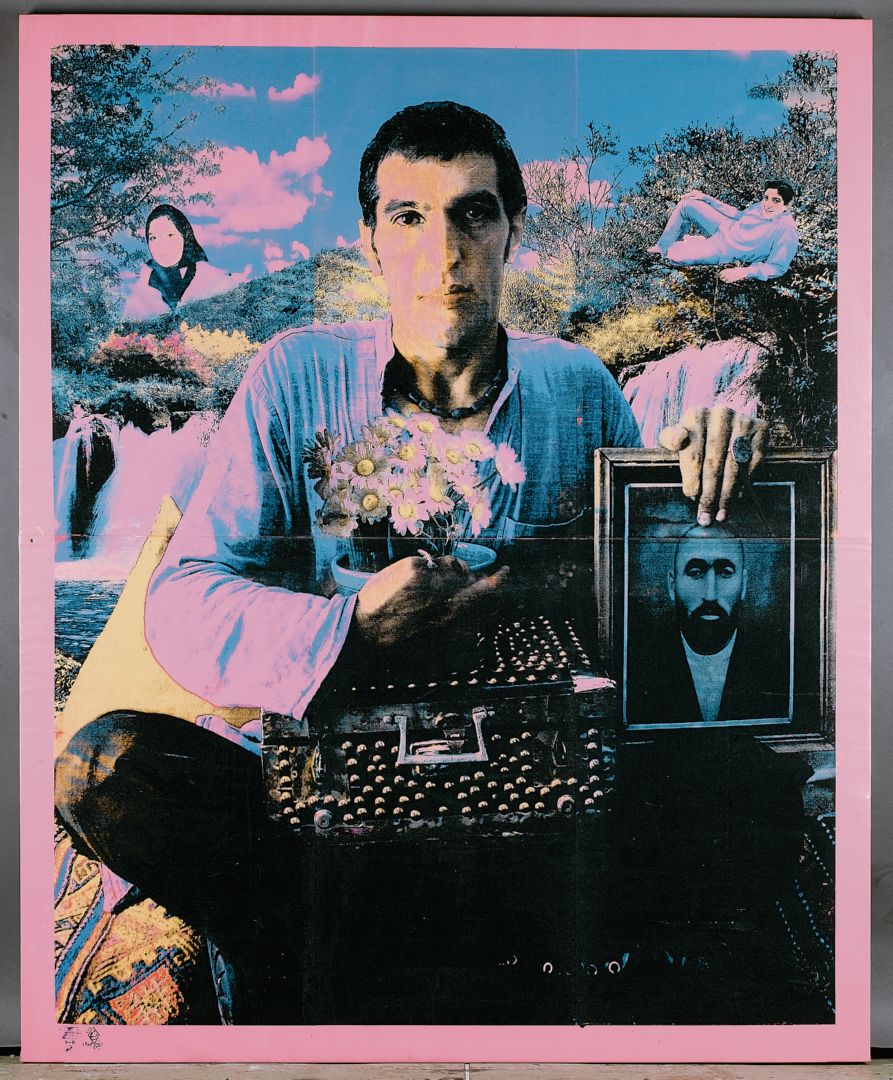 Khosrow Hassanzadeh. Terrorist: Khosrow. 2004. Acrylic and silkscreen ink on canvas
Soaring high towards the sky, resides a selection of Mohammed Afkhami’s art collection which lines the walls of his Burj Daman residence in Dubai. Since 2005, the Iranian financier has amassed over 300 works of modern and contemporary Iranian art. “Originally, I wanted to buy enough art to fill up my walls,” Afkhami recounts. “That happened very quickly.” Over the years, his art collection evolved as he accrued a cross-section of Iranian art from the 1950s to the present day. Afkhami says he aims to showcase his art collection on a museum tour throughout art institutions in the US for as long as possible, subsequently maximising the exposure of Iranian art. The North American debut of 27 contemporary artworks from his collection are currently displayed at the exhibition, Rebel, Jester, Mystic, Poet: Contemporary Persians at the Aga Khan Museum in Toronto, Canada. Curated by Fereshteh Daftari, the showcase presents a survey of Afkhami’s post-revolution Iranian art which explores topics from politics and gender to religion through perspectives of rebellion, humour, mysticism and poetry. “The whole raison d’être of the Aga Khan Museum is to promote a better understanding of different parts of the world,” Afkhami says. “It sets a fantastic tone for bringing works from the broader Islamic world to a Western audience.” Among the politically-charged artworks include a compelling self-portrait by Khosrow Hassanzadeh entitled, Terrorist: Khosrow. Hassanzadeh created the work in 2004, which questioned Iran’s association with terrorism when the former US President, George W. Bush coined the term “axis of evil.” Iran was one of the nations included in the axis which posed an alleged threat to the US. “What is ironic and sad is that here we are almost 13 years later after that artwork,” Afkhami recounts. “It is almost as if it could have been made today. Because, again the same labelling and the same stereotyping is going on.” The exhibition’s curator, Fereshteh Daftari insists that not all the artworks on view convey war and a world in turmoil. “Appropriately, the exhibition concludes with the video installation by Morteza Ahmadvand,” Daftari notes. “Who calls for the unity of the three Abrahamic religions: Judaism, Christianity and Islam.” In light of the US President’s executive order, Daftari believes the art on display can offer alternative perspectives of Iranian culture. “His executive order paints Iranians as potential terrorists,” Daftari says. “Not as inheritors of culture, modern and ancient, not as reservoirs of intelligence and creativity. Not as a nation of deep humanity with an ability to express profound thoughts in a language of exquisite beauty – a perspective RJMP: Contemporary Persians does offer.”
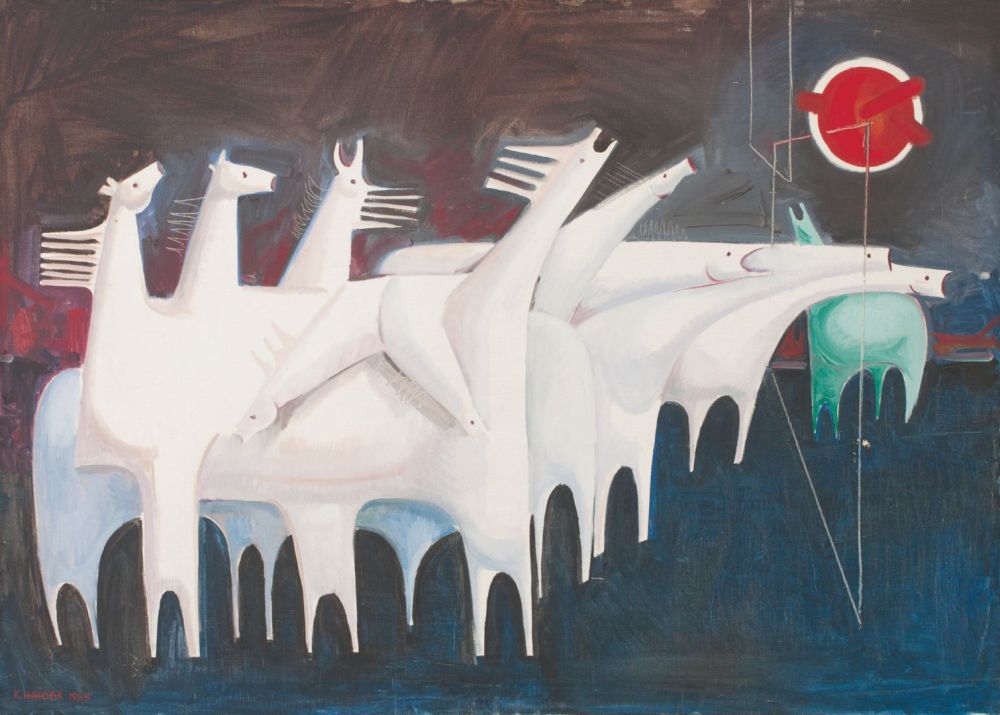 Kadhim Hayder. Fatigued Ten Horses Converse with Nothing (The Martyr’s Epic).1965. Oil on canvas. 91 x 127 cm
In Sharjah, the Barjeel Art Foundation continues to bridge the cultural divide between the Middle East and the West. Founded in 2010 by the Emirati art collector, Sultan Sooud Al Qassemi, the foundation aims to preserve and exhibit Al Qassemi’s extensive collection of modern and contemporary Arab art. When Al Qassemi established the foundation in 2010, there was hardly any Middle Eastern art showcased at institutions in the West. Al Qassemi believes the representation of Middle Eastern art has progressed over the years as the region continues to capture news headlines across the world. “Some Western museums have received financial grants from Middle Easterners who have supported purchases,” he says. “While others have hung Middle Eastern works are a result of the political climate – playing an important role in facilitating cultural dialogue between people.” Exhibitions which the Barjeel Art Foundation are currently showcasing include Chefs-D’œuvre de L’art Moderne et Contemporain Arabe at Institut du Monde Arabe in Paris and Modern Art from the Middle East at Yale University in Connecticut. The foundation’s forthcoming exhibitions will take place at the Hessel Museum of Art in New York and the Katzen Arts Center in Washington D.C. The Barjeel Art Foundation’s exhibitions provide an insight into the Middle East’s illustrious history from the rise and fall of Pan-Arabism to the Gulf War and the Arab Spring. “Ultimately art can humanize people,” Al Qassemi states. “Art shows that human beings have the same basic needs, similar fears and the same dreams for a better life.” He highlights a work from his collection on display at the Institut du Monde Arabe in Paris by the Algerian artist Kader Attia, entitled, Demo(n)cracy. With a play on the terminology, Attia addresses conflicts with the development of democracy. “Demo(n)cracy reflects how a promise can turn into a menace,” Al Qassemi says. “Something that all of us would do well to learn lessons from.”
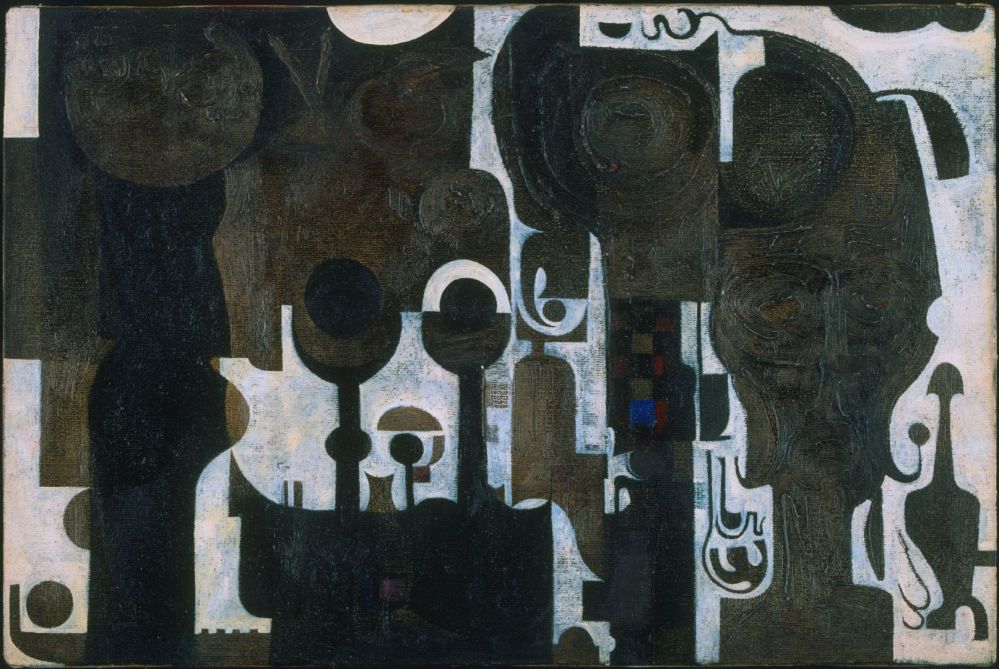 Ibrahim El-Salahi. The Mosque. 1964. Oil on canvas. 30.7 x 46 cm
In New York, the Museum of Modern Art (MoMA) has taken a direct stance against Trump’s executive order. Days after the US President issued the first travel ban, MoMA opposed the order by re-hanging artworks from the museum’s permanent collection conceived by artists from the nations included in the ban. A selection of works by modern masters such Picasso and Matisse were replaced with works from artists hailing from Iran such as Shirana Shahbazi, Parviz Tanavoli and Charles Hossein Zenderoudi, including a work by the Sudanese artist Ibrahim El-Salahi, entitled The Mosque. A placard is placed alongside each work which states: “These artworks from the Museum’s collection are installed throughout the fifth-floor galleries and The Agnes Gund Garden Lobby to affirm the ideals of welcome and freedom as vital to this Museum, as they are to the United States. These works are by artists from nations whose citizens have been or are being denied entry into the United States by recent presidential executive orders.” A spokesperson for the MoMA stated the artworks will remain on view for an indefinite time, while the museum’s art collection periodically rotates.
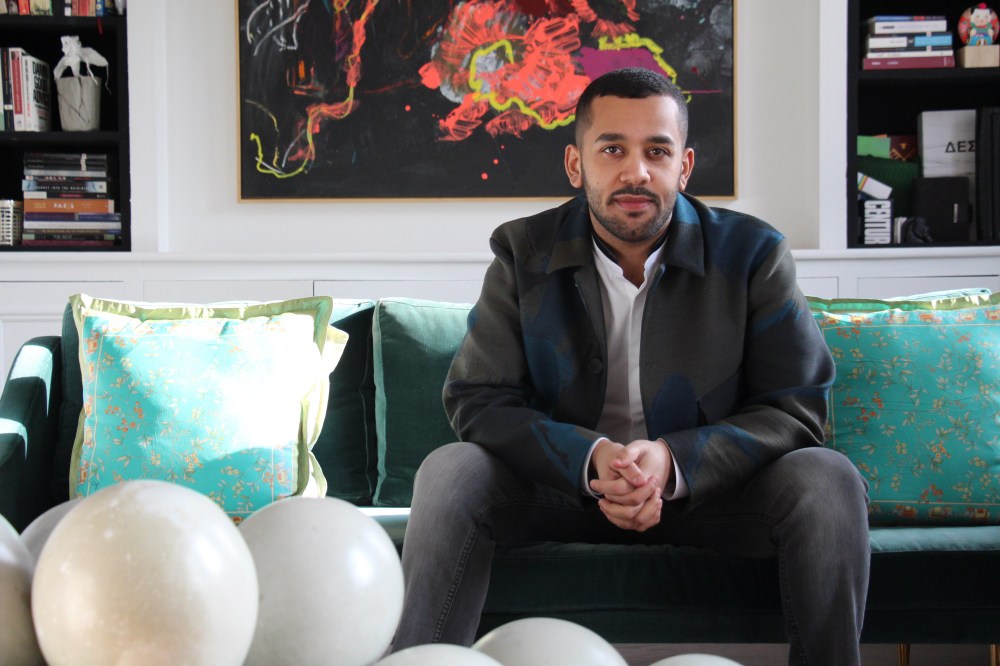 Portrait of Sheikh Mohammed Rashid Al-Thani. Photograph: Filip Cvetkovic
Elsewhere in New York, Qatar’s Sheikh Mohammed Rashid Al-Thani launched the Institute of Arab and Islamic Art (IAIA) in May. The Manhattan-based, non-profit institute aims to foster the artistic and cultural dialogue between New York and the Arab and Islamic world through art exhibitions, education programmes and artist residencies. On what compelled Al-Thani to launch the institute, he says it was principally due to an inadequate representation of Arab and Islamic Art in New York. “Our narratives are being written by Western foundations,” Al-Thani says. “They try to the maximum of their capacity to represent the region, but our region needs an institution that is driven by our people, our artists and our curators to write our own narratives to present to the Western culture.” Al-Thani insists that the inception of the institute is not a direct stance against Trump, but rather a reaction to what he describes as, “the stereotypes and the misconceptions that Muslims and Arabs have been struggling with for the past two decades.” The inaugural exhibition debuted on May 3, 2017 and showcases the works of artists exploring notions of Islamic architecture and geometry.
The shared sentiment remains that art can pave the way for a greater understanding between the East and the West. While time will tell if the current initiatives will have a lasting effect on reorienting perceptions on a region which has so often been misconstrued. – Nada Bokhowa
 The Desert Rose