This article was first published in the summer 2017 issue of Harper’s Bazaar Art Arabia
New York has long been considered a thriving multi-cultural metropolis, a city which showcases a surge of the world’s rich array of cultures throughout its institutions and museums. The launch of the Institute of Arab and Islamic Art (IAIA) in New York on May 4, 2017 marked a historic moment for the representation of Arab and Islamic culture – a region which has not yet established a cultural institute in New York. IAIA was conceived in 2014 by Sheikh Mohammed Rashid Al-Thani, who is based in New York and hails from the Qatari royal family. The non-profit institute aims to facilitate the artistic and cultural dialogue between New York and the Arab and Islamic world through quarterly art exhibitions, education programmes, artist residencies and collaborations with cultural organizations.
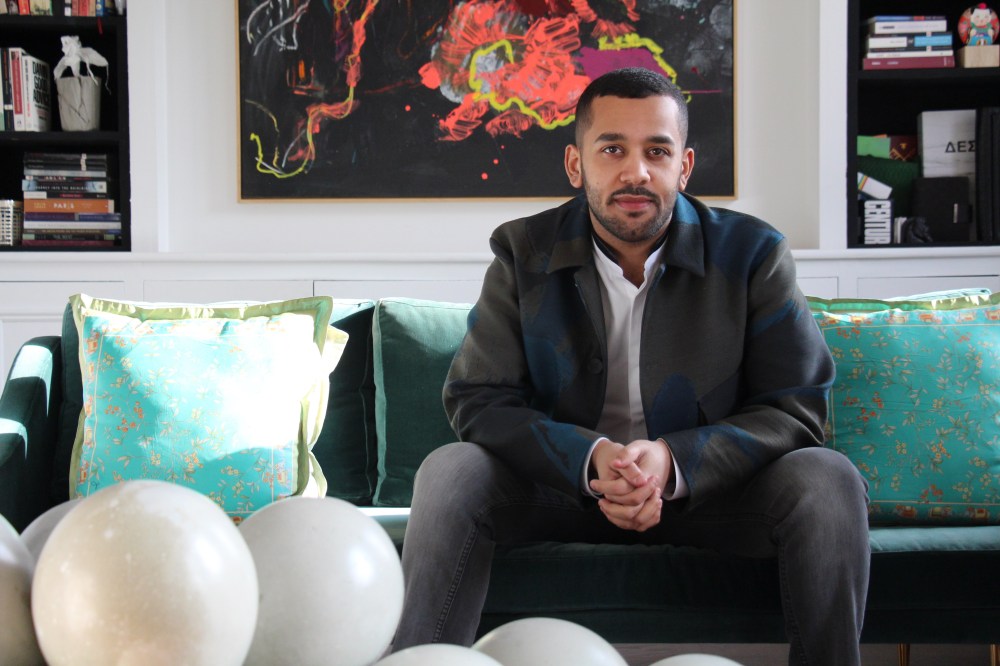 Portrait of Sheikh Mohammed Rashid Al-Thani. Photograph by Filip Cvetkovic
Although Al-Thani commenced his career working for the United Nations, it was his passion for art which eventually led him to obtain a master’s degree in Paris, where he wrote his dissertation on the French Post-Impressionist painter, Paul Cézanne and the advent of Fauvism and Cubism. He sought to further pursue the evolution between the French masters and Abstract Expressionist and Conceptual art movements when he moved to New York in 2014. The conception of IAIA occurred towards the end of 2014, due to what he perceives as an inadequate representation of Arab and Islamic Art in New York. “Cultural institutions have a presence in New York,” Al-Thani says. “You have the Asia Society, Swiss Institute, Jewish Museum and El Museo del Barrio.” He adds, “There is a representation from all cultures. What shocked me the most is that there is a lack of representation from our cultures and civilisations. That’s why I thought we ought to be part of this conversation.” Although eminent institutions in New York such as The Metropolitan Museum of Art and The Museum of Modern Art (MoMA) exhibit Middle Eastern and Islamic art, Al-Thani believes the region requires a representation from its own creative forces. “Our narratives are being written by Western foundations,” he proclaims. “They try to the maximum of their compacity to represent the region.” He adds, “But our region needs an institution that is driven by our people, our artists and our curators to write our own narratives to present to the Western culture.” Although the exhibition occurs amidst US President Donald Trump’s continued efforts to ban several Muslim-majority nations from entering the US, Al-Thani insists it is not a direct stance against Trump, but rather a reaction to what he says are “the stereotypes and the misconceptions that Muslims and Arabs have been struggling with for the past two decades.”
 Institute of Arab and Islamic Art (IAIA) logo
The IAIA’s debut showcase, entitled Exhibition 1 takes place at 3 Howard Street in Manhattan and features artworks on paper which explore the realm of Islamic geometry and architecture. The four participating artists include Monir Shahroudy Farmanfarmaian, Dana Awartani, Zarina Hashmi and Nasreen Mohamedi. Although the artists hail from Iran, Saudi Arabia and South Asia, Islamic art serves as a focal point for their respective artistic practices. The exhibition examines how the intricate aesthetic similarities of Farmanfarmaian and Awartani’s ties to sacred Islamic geometry seeps into the artists’ consciousness and subsequently affects their artistic expression. While South Asian artists such as Hashmi and Mohamedi’s works convey a more minimalist interpretation of Islamic architecture and geometry. “I wanted to celebrate the depth and the differences,” Al-Thani says. “How independent those artists are from one another, yet drawing from a very similar experience.” Al-Thani hopes IAIA’s showcase of four female artists will challenge Western misconceptions of women in the region. “The public needs to know that we are not shying away from showing our female artists,” he says. “Female artists are not marginalised and they are the voice of the artistic practices that are coming from the region. Their voices are heard and their works are being appreciated and represented.” He believes the exhibition’s showcase of two generations of female artists is also imperative as it conveys the consistency of artistic talent from the region. Ultimately, Al-Thani hopes Americans will perceive past gender and race and appreciate the rich heritage of the Islamic world. “I want them to look beyond what they see and look at the incredible Islamic architectural heritage,” he notes. “To see how those buildings, mosques and tombs will eternally be a part of our existence.”
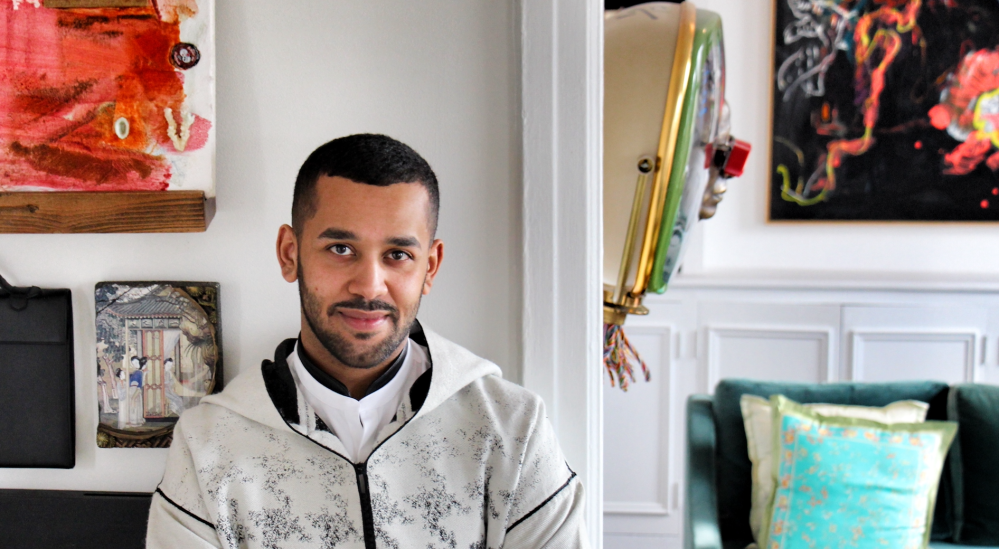 Portrait of Sheikh Mohammed Rashid Al-Thani. Photograph by Filip Cvetkovic
While the IAIA continues to search for a permanent space in New York, the institute functions as a non-profit which accepts donations from the public. Al-Thani asserts the importance of engaging Middle Eastern and Islamic art with the multi-cultural scene in New York. “We have to be active participants of this global environment that is in New York,” he says. “The resources and knowledge from the Arab and Islamic world should be shared for a greater purpose.” – Nada Bokhowa
This article was first published in the summer 2017 issue of Harper’s Bazaar Art Arabia
 The Desert Rose